The 12 Days of Christmas and the Epiphany Feast, Heppy-style.
Tue, 6 Jan 2026 18:45:40 +1000
By: gosh'at'DigitalFriend.org (Steve Goschnick)
Today is the 6th of January, called the Epiphany, a Christian Feast Day, the day immediately after the 12 Days of Christmas. This date always reminds me very warmly of Heppy. whom I'd had the very good fortunate to become acquainted with, in the early 1990s. More formally, Mr John Hepworth, an esteemed Australian journalist, columnist and one-time (Melbourne) editor of the National Review in the 1970s; and before that an actor and playwright; and before that, a volunteer in the AIF during WWII in which he'd fought in both the Middle East and in New Guinea, north of Kokoda. At the time of our meeting, I knew none of that extensive background of his. In the 1990s he and his wife Margaret used to throw open their house in Toorak, and cook a huge feast to all-comers as their gift to them in celebrating Life, on this day of the Calendar each year. It was appropriately known as: Heppy's 'Twelve Days of Christmas Party'.
The first one that I went to was in January 1993. In March of the year before, I'd hired Heppy to write me some fictional letters that were to appear in a dynamic form within a computer/ video game I was coding and producing at the time. The letters were to form a part in the player's quest. These letters had to be short, pithy and personal, and yet also needed to seem as authentic as possible. This brevity as my primary requirement, was to suit the fast-moving pace in the video game genre, where players had little time or inclination to read great slabs of text. And Hepworth (that's how he signed his correspondence - just the surname) was the right man for the job, as it turned out. I'd been introduced to him via Stefan Mager, a mutual friend, at Stefan's company called Dynamo House, situated in Richmond just across the river from the Hepworth's house. In fact, Stefan had published one of his books with an artwork cover by their mutual friend and colleague, Michael Leunig, titled: Colonial Capers (1986).
Heppy faxed me the first sample of his writing, 13 pages worth of brief and wonderfully varied letters. Here's the first letter off that rank, to give you an idea of what I was after, which is what I got:
Darling Grigor,
You'll not get around me this time! I'm not amused. Shocked to hear that you have been behaving so disgracefully - and are so proud of yourself about it.
You've made a serious mistake and got yourself into another fine mess. It's not funny. Remember what the American author, Dorothy Parker, said:
"It's not the tragedies that kill us, its the messes."
If you weren't my favourite brother, I'd never speak to you again. And I certainly wouldn't be sending you this watch for your birthday next month.
Your loving (and irate) sister,
Katrina
My first meeting with Heppy was at his house in Toorak. He wore a long colourful nightshirt and a smoking cap from another era. When I got inside, it was a well worn and homely furnished place, where every unique piece clearly had a story to it. After the offer and acceptance of a drink, and a couple of his lively anecdotes we proceeded to his writing space, which was up on the roof!
It involved climbing up one of those tight-turning wrought-iron spiral staircases, accessed via a step out into a back patio area. He advanced up the steps before me, very slowly as he said he was down to half a lung, after the removal of one lung and the other half, both wracked with cancer. For a man clearly approaching death, sooner than later, he was certainly very jovial. His choice of sleep-out and work quarters up there was very spartan - it had a quick makeshift flattish corrugated iron roof, a couple of the walls above waist height were missing entirely, with a colourful clothe as a one-piece curtain across each gap, to keep the sun at bay more so than the wind. A single bed, a small flat desktop, and an old typewriter, and the two of us filled the entire free space. I instantly appreciated why he liked it up there, despite the arduous climb up the steep staircase powered only by that remaining half lung. There was a good canopy of leaves to the north from big trees along the boulevard out front, and a cool breeze coming off the nearby Yarra River, which was probably a perpetual phenomenon. For someone struggling to breathe, that river breeze was just as much a lifeline as was the water in the river to the fish in it.
I gave him my letter writing Brief, in which he instantly appreciated the constraints of the video game as a medium. After an hour or so, off I went, knowing straight away that despite me not having any former knowledge of this fellow, here was a real Australian character of some very great depth. There was also something Saintly about him evident right away, and though his words were brief, the way he weaved them was laden with wisdom and empathy, even the little ones. He would Fax me his letters in good time, all typed up, and as I was leaving he invited me to come back to his next two parties held 6 months apart, one in a few months, and the second, his 12 Days of Christmas Feast, "held every year on the 6th of January".
I got along to the one in the forthcoming New Year. It was something of a party for sure. He and his wife Margaret cooked up and served copious amounts of food to a large thong of people, randomly spread throughout the house, except for his rooftop retreat. There were writers and actors and entrepreneurs. Old and young. A tune from a piano waffled through the place. A youngish operatic singer burst into song at one point. Many had come from the immediate environs of Toorak, both richly housed people right through to several homeless drifters afflicted with schizophrenia . . . One of their number informed me of his mental condition right away, and that he was no longer homeless, as Heppy had let him stay-over for some many weeks now, couch surfing. During the party I was reminded of a line in the writing in Steinbeck's Cannery Row, one of my favourite short books, specifically about the nature of parties before the crescendo at Doc's place there-in: "The nature of parties has been imperfectly studied. It is, however, generally understood that a party has a pathology, that it is a kind of an individual and that it is likely to be a very perverse individual. And it is also generally understood that a party hardly ever goes the way it is planned or intended." Heppy's party wasn't of the cataclysmic dimension of Doc's in the final chapters of that book. Heppy though was a gentleman in his early 70s at this point and well past much of that sort of thing, though some of his party goers wouldn't have been out of place in Steinbeck's colourful story.
But Heppy the host, was an extraordinary Host on a grand scale on this day of the Epiphany. He clearly had a big Soul drawn from a big life, and he was pouring it out generously to all that came within his arc. The life of Heppy's party each year was a preordained high-energy success, no doubt. Though, I didn't get to a second to compare them, I'm certain they were.
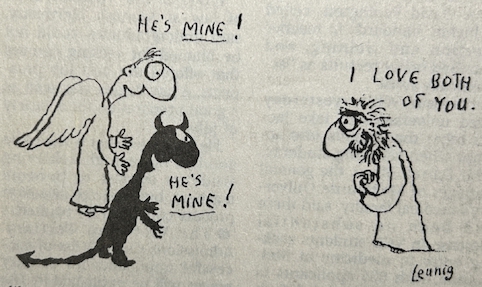
Heppy died on the 24th January 1995. Michael Leunig, his friend and collaborator on several books (covers, illustrations), did the cartoon above as a tribute to mark his passing.
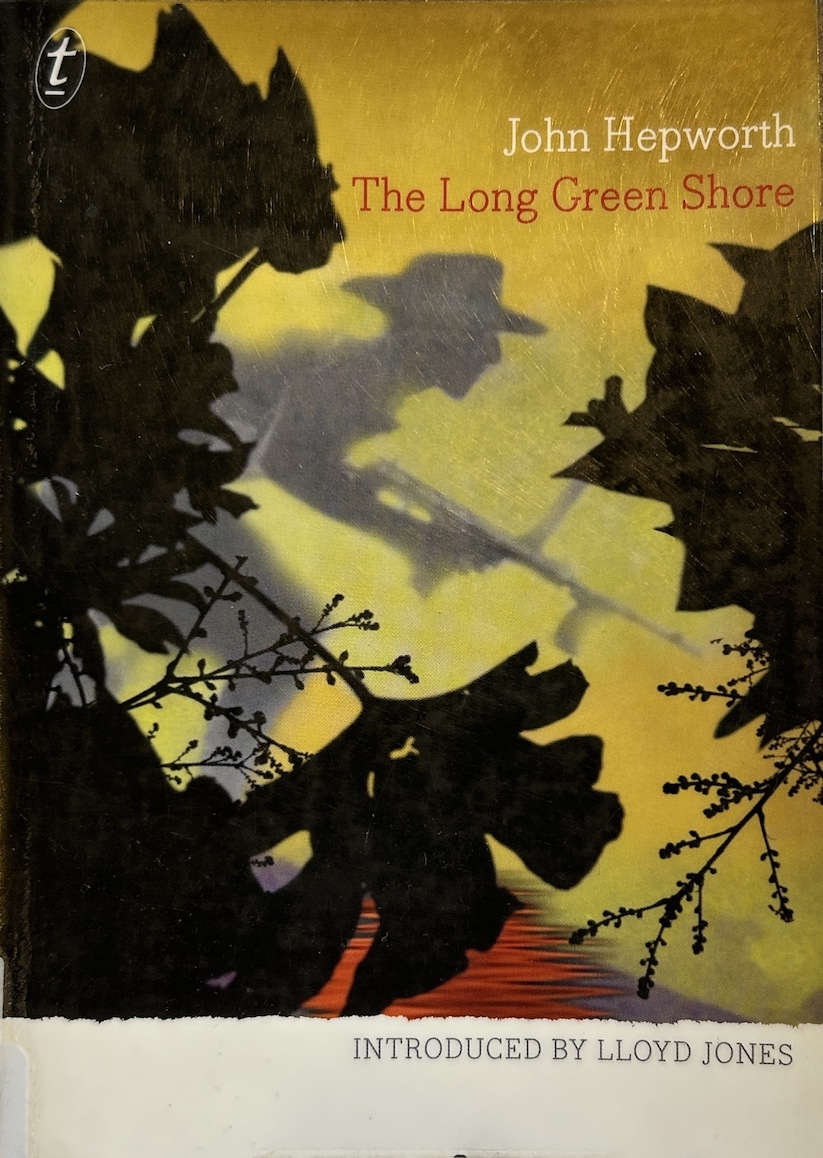
I hadn't read any of his published literary works until quite recently, when I picked up his now famous war novel 'The Long Green Shore'. I spotted it in a surplus book sell-off by the local Library. It was published in 1995, shortly after his death. Gratefully, he'd heard that it was to be finally published, shortly before he passed. The blurb says he wrote it as a young man on his return from the jungle warfare in the late stages of WW 2, in northern New Guinea, where he lost many of his comrades doing battle against the occupying Japanese. He'd clearly edited it a few times down the years, as it holds a lot of wisdom and personal insights. The experiences and emotional depth are drawn from that cauldron hell pit 50 years before publication, but it has the turn of phrase and deep insight, available after many years of contemplation, of well-honed writing, and the charting of many variations of the human soul.
The book is as much a tour of human thoughts and the psyche during those days spent by (mainly) young soldiers dealing with: the daily grind, the training for battle, facing individual fears, the war bureaucracy, the variation in task and risks along the chain of command, the buddy mode of broken sleep versus lookout, paired in rain-saturated pits dug in the leafy jungle, the constant threat of snippers, hospital recouperation, the randomness of death under fire, and the personal betrayals between (some of) them and their loved ones back home, who for all intensive purposes, were effectively living in another dimension. Also evident in this book, was that his personal empathetic dealing with people with severe mental trauma stretched back to his time there with comrades in war, several of whom went completely 'troppo'.
The communication channel between the soldier and their distant loved one back home, was by letter writing. Little wonder Heppy was such a master of it when I'd encountered him in the 1990s.
In the book the narrator's good friend in the jungle was a fellow called Janos. 'Janos had two letters - one from his mother and one from Mary.'
But Mary dropped a bombshell of her own: she'd just become engaged to another man back in Australia: 'A Yankee marine - she wants to live in Idaho - she sends her love and hopes I understand!'
The letters from sweethearts were a solders lifeline, their saving grace.
'Even when you know nothing will come of it, . . . to know that there's a door that you can knock on first when you get home. So long as you've got a contact you can feel you're not all soldier - you can be half a man still.'
Some of the letters in his book are very short ones and the brevity of them itself, says much. Others are page and a half of authentic heart felt feelings, flowing down the paper. The exception is the last one nearing the end of the book, which shows no compassion and is devoid of feeling:
"Dear Mrs Jenner,
I am writing this on behalf of the platoon.
Your son died saving some of our lives.
We were cut off and surrounded and there was a break made through our lines. Bill stopped that breakthrough and saved us. But he was killed doing it.
We will never be able to tell you how we felt about him. All we can say is that he died most bravely and he was our friend . . ."
Not that we weep . . . our hearts are dry - but our brother is dead."
By then the narrator's heart is completely numb and dry. He is done. He is done with death and war. However, as he looks towards Australia on the boat out of that leafy green hell, he finishes with something of a pledge. He's not yet done with Life nor with god.
Indeed, Heppy went on with a big Life on his return from WW2, one worth at least two, his own and another for his fallen brothers. It may be in the fiction category but this book was also his seminal Story. His 12 Days of Christmas Feast which raged gleefully down the years, but one such reverberation. Half a lung was of little consequence to Heppy, he was on a life long mission. He worked hard on things that matter and he celebrated Life.
Steve Goschnick (gosh'at'DigitalFriend.org)